
GLOBAL ECONOMICS AND POLITICS

Leo Haviland provides clients with original, provocative, cutting-edge fundamental supply/demand and technical research on major financial marketplaces and trends. He also offers independent consulting and risk management advice.

Haviland’s expertise is macro. He focuses on the intertwining of equity, debt, currency, and commodity arenas, including the political players, regulatory approaches, social factors, and rhetoric that affect them. In a changing and dynamic global economy, Haviland’s mission remains constant – to give timely, value-added marketplace insights and foresights.

Leo Haviland has three decades of experience in the Wall Street trading environment. He has worked for Goldman Sachs, Sempra Energy Trading, and other institutions. In his research and sales career in stock, interest rate, foreign exchange, and commodity battlefields, he has dealt with numerous and diverse financial institutions and individuals. Haviland is a graduate of the University of Chicago (Phi Beta Kappa) and the Cornell Law School.


Subscribe to Leo Haviland’s BLOG to receive updates and new marketplace essays.

RSS View Leo Haviland's LinkedIn profile View Leo Haviland’s profile


LIVING ON BORROWED TIME- AMERICA THE DEBTOR © Leo Haviland November 12, 2012

Economic experts, political pundits, and marketplace wizards have made much of America’s looming federal “fiscal cliff”. It has become commonplace to declare that not only for the near term, but also for the misty long run horizon, difficult decisions await the Washington leadership. Of course the nation has assets. However, there has been much less emphasis on America’s “debt hole”, the enormous indebtedness of America as a whole (not just the federal government situation) as a percentage of nominal GDP.

The debt growth trend in recent decades and its mountainous overall level argue that a culture of debt (and entitlement) exists in the United States. Rising debt as a percentage of GDP preceded its acceleration during the glorious Goldilocks Era that ended around mid to late 2007. Since the so-called recovery began to motor forward in 2009, overall United States indebtedness has not declined much. Though consumer indebtedness has declined modestly in the past few years, federal indebtedness has skyrocketed. Thus in a representative government, people (“we, the people”) correspondingly remain very indebted.

And is the President or any of the Congressional Democrats or Republicans in their undoubtedly brilliant “plans” talking of the merit of engineering budget surpluses at any time in the next several years (if ever)? In addition, smoothly singing its mandate hymn, the financial fire-fighting Federal Reserve devotedly has assisted debtors by repressing interest rate yields, printing money (quantitative easing), and other measures. This highly accommodative and sustained central banking liberality not only assists debtors. The Fed thereby provides short term benefits such as boosting GDP, rallying the US stock marketplace, reducing unemployment, and buying time for a fiscal solution. Might there be some long run costs to such supposedly prudent Fed actions? For example, these generally popular Fed policies nevertheless also reflect and encourage the debt culture and delay difficult (responsible) political decision-making and consequently some amount of painful reckoning.

What is the more probable outlook? Perhaps patching over the US’s debt problem, particularly on the federal landscape, will occur, thus easing fears regarding the outbreak of a financial disaster. On the federal fiscal front, the passing of and results of the 2012 election may spark bipartisan efforts that result in a temporary fix of existing difficulties. However, as before the election, there is a Democratic President, Democratic Senate, and a Republican House of Representatives. Remember the lyrics of a famous anthem by The Who: “Meet the new boss Same as the old boss” (“Won’t Get Fooled Again”). And in the Senate, the Democratic majority is several seats short of the 60 votes necessary to stop legislative debates. Even to induce an attractive temporary fix, it is more likely that fearsome existing debt troubles probably will have to worsen further. And don’t overlook the need to raise the debt ceiling again.
Read the rest of this entry »
COMMODITIES IN CONTEXT- NOVEMBER NOTES © Leo Haviland Four notes written during November 2012

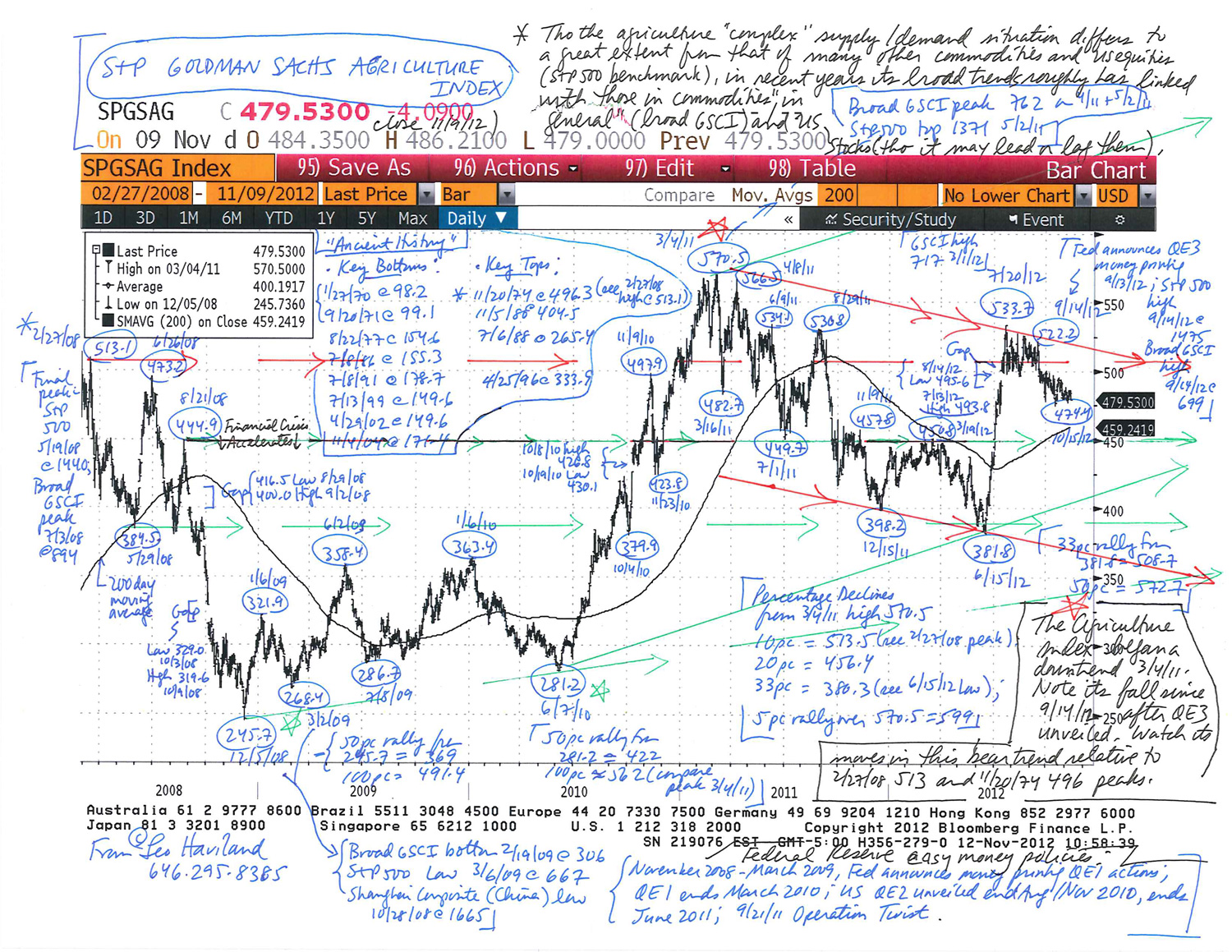
Regarding the S+P Goldman Sachs Agriculture Index (11/12/12):

Thus in recent years, some major trends in the Goldman Sachs Agriculture Index have paralleled those in the broad GSCI and US stocks (S+P 500). There of course have been leads (lags) in the timing of major price turns between the GS Ag Index and the broad GSCI and the S+P 500.

Despite a rally to the 7/20/12 plateau at 534, the recent failure of the Ag Index to sustain a move over the 2/27/08 summit around 513 and the 496 peak of almost 40 years ago (11/20/74; also see the price gap in summer 2012 around that 496 level) is a bearish sign. So is the Ag Index’s erosion since- and despite- the Federal Reserve’s announcement of QE3 money printing on 9/13/12. Since 9/14/12, note the similar slumps in the S+P 500 and the broad GSCI.

Chart-Analysis--Goldman-Sachs-Agriculture-Index-(11-12-12)
Chart Analysis- Goldman Sachs Agriculture Index (11-12-12)

Regarding metals marketplaces (“Metals, Marketplaces, and Meltdowns”, 11/8/12):

In 2011, key base and precious metals began bear trends. Take a look at the attached charts. Though different metals commenced their descents at various times, they all have fallen. Even gold has not surpassed its 9/6/11 top at 1921.

The Federal Reserve unveiled a third round of money printing 9/13/12. However, unlike what occurred after QE1 and QE2, US stocks (S+P 500 and Dow Jones Industrial Average) have not sustained an advance. Stock and commodity bulls might argue that only a few weeks have passed since mid-September. Nevertheless, the S+P 500 (9/14/12 at 1475) and Dow Jones Industrial Average (10/5/12 at 13662) made highs and then slumped. Declines in gold, silver, and the London Metal Exchange’s LMEX Index (and Brent/NSea and NYMEX crude oil) coincide with the 9/14/12 to 10/5/12 top in stocks.

In recent years, price and time trends of commodities “in general” and stocks have roughly mirrored (“confirmed”) each other. Thus the weakness in the overall metals complex is a noteworthy bearish warning sign for US (and “related”) equity marketplaces.
Read the rest of this entry »

ECONOMIC AND POLITICAL LINES (c) Leo Haviland October 22, 2012

Highlight two International Monetary Fund comments in its recently unveiled “Fiscal Monitor” (October 2012). “With downside risks in the global economy mounting, policymakers must once again tread the narrow path that will permit them to continue strengthening the public finances while avoiding an excessive withdrawal of fiscal support for a still-fragile economic recovery.” (page ix). And: “In most advanced economies, the near-term fiscal stance has to walk the fine line between continued adjustment and supporting the economy.” (p6).

This IMF rhetoric, which many other luminaries embrace, of “tread the narrow path” and “walk the fine line” offers hope for the global economy and for the United States in particular. Maybe subtle financial and political sorcerers somehow can escape the dilemma of an economic downturn (too slow growth or recession) and the consequences of additional (irresponsible) substantial deficit spending! Have faith that wise guardians can discover a middle way to evade further suffering!

In the amazing Goldilocks Era, didn’t substantial and growing worldwide debt and leverage joyously promise and provide nearly limitless opportunity for almost everyone (“us”) to prosper with very little (or at least manageable) risk? In the aftermath of the wonderful Goldilocks epoch, should we believe that the implications of significant leverage and mountainous debt accumulation can be magically pain-free, at least over some misty medium term or long run vista?

Despite such entrancing sermons of narrow paths and fine lines from many respected central banking and political guides, economic and political pilgrims should ask if such a path or line exists in practice. It probably doesn’t. Is there really a way for the United States to avoid the looming fiscal cliff and other long run deficit challenges without significant hardship? Probably not.

Most observers are not focusing closely on the potential composition of the Senate. They should. The Senate election result probably will have notable consequences for legislative action (or inaction) in many domains. For example, think of the troubling fiscal cliff and the terrifying long run deficit problems.

Clairvoyants on balance believe the Democrats probably will maintain control of the Senate. Even if the Republicans gain an edge in the Senate, it would be very surprising for them to capture anything close to 60 seats. According to Senate rules, to end debate (halt filibusters) on a legislative proposal (bill), 60 of the 100 Senators must agree to do so (invoke cloture). The sixty votes do not have to all be from the same party. Nevertheless, the failure of a Senate majority party to control 60 or more Senate seats means that its opponents generally can block the majority party’s legislative efforts.

So suppose the House is Republican, and the Senate is Democratic (or even imagine a modest Republican majority). Given such Congressional division, it will be a major challenge for the parties to readily resolve issues over which they disagree dramatically, such as on how to repair the federal deficit disaster. In that situation, the party membership of the winner of the duel for the Presidency matters much less. After all, for the past several years, the Republican House and the Democratic Senate stubbornly have faced each other. With these battle lines, there has been at best little progress on reducing the deficit. Why should having a Republican President instead of a Democratic one change this partisan deadlock in any notable fashion?

FOLLOW THE LINK BELOW to download this market essay as a PDF file.
Economic and Political Lines (10-22-12)
Chart- Commodities- Broad GSCI (10-22-12)

AMERICAN MARKETPLACES: AT THE CROSSROADS © Leo Haviland October 15, 2012

The world’s long-running economic crisis of course has not limited itself to either one nation or one region. However, at its outset in 2007, most did not anticipate the scope or length of the disaster. Weren’t potential risks to the international economy rather modest? Weren’t issues related to the United States real estate marketplace mostly relevant only to that domain and that nation, and likely to be restricted to them? Yet substantial debt and leverage (and other intertwined issues) and their consequences were not confined either to American territory or the real estate playground.

The recent Eurozone chapters of this terrible trouble supposedly started with so-called peripheral nations such as Greece, Portugal, and Ireland. Countries such as Greece indeed first captured headlines. However, that does not demonstrate that causes of Eurozone problems necessarily started only in them. In any event, “difficulties on the periphery” engulfed the rest of Europe and traveled around the globe.

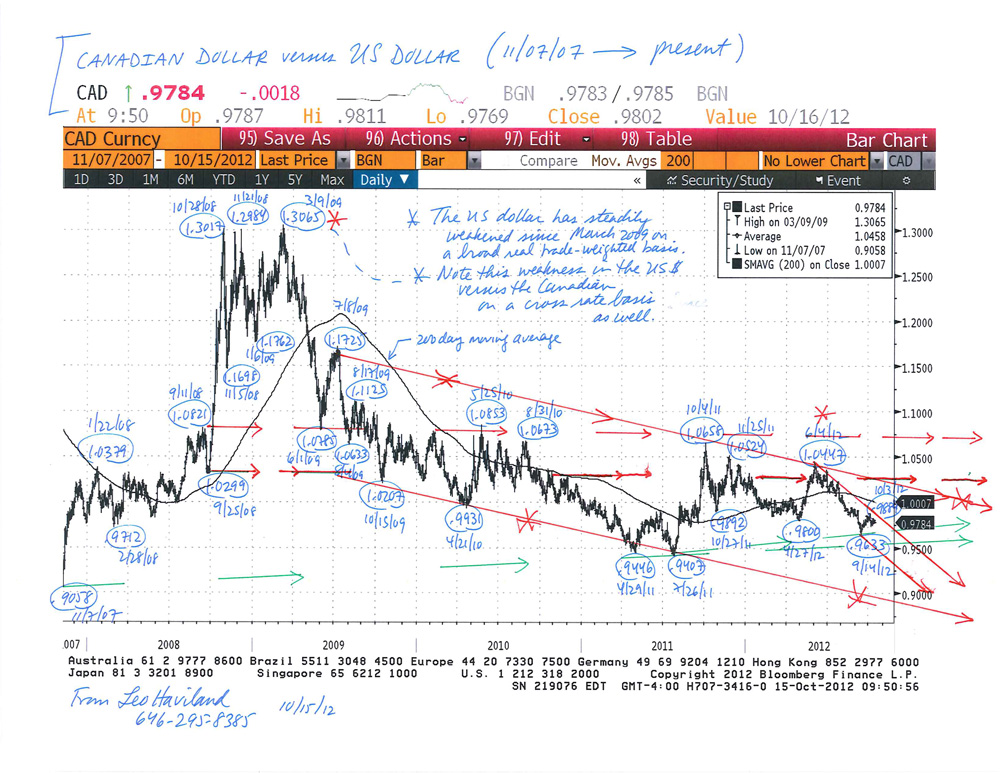
Despite broad concerns regarding worldwide economic problems and risks, despite the widespread past and current fascination with the European scene, suppose one focuses on aspects of the American stage, beginning with some highlights involving the United States alongside Canada and Mexico in the foreign exchange context. This survey of America and its geographic neighbors underlines the weakness of the United States dollar and the size of America’s fiscal troubles. This suggests the merit of inquiring into US currency, stock, interest rate, and commodity marketplace past and future relationships in the context of Federal Reserve easing policies and America’s fiscal problems.

The broad real trade-weighted dollar probably will continue to weaken. The dangerous United States fiscal situation probably will not be genuinely fixed in the next several months. A full- fledged threat of a federal fiscal catastrophe likely will be necessary for sufficient progress in that sphere to occur. Though the United States is not the center of the universe, the effects of further dollar feebleness and the worsening of the country’s fiscal crisis will radiate worldwide.

The S+P 500 has made or soon will make a significant peak.

Thus the emerging (current) story and trend appears to be: weaker dollar (TWD), weaker S+P 500, and higher government rates (UST 10 year benchmark). This vision admittedly is dramatically different from the current popular faith in these marketplace relationships.


FOLLOW THE LINK BELOW to download this market essay as a PDF file.
American Marketplaces- At the Crossroads (10-15-12)
Charts- US Dollar v Canadian Dollar, Mexican Peso (10-15-12)