

GLOBAL ECONOMICS AND POLITICS

Leo Haviland provides clients with original, provocative, cutting-edge fundamental supply/demand and technical research on major financial marketplaces and trends. He also offers independent consulting and risk management advice.

Haviland’s expertise is macro. He focuses on the intertwining of equity, debt, currency, and commodity arenas, including the political players, regulatory approaches, social factors, and rhetoric that affect them. In a changing and dynamic global economy, Haviland’s mission remains constant – to give timely, value-added marketplace insights and foresights.

Leo Haviland has three decades of experience in the Wall Street trading environment. He has worked for Goldman Sachs, Sempra Energy Trading, and other institutions. In his research and sales career in stock, interest rate, foreign exchange, and commodity battlefields, he has dealt with numerous and diverse financial institutions and individuals. Haviland is a graduate of the University of Chicago (Phi Beta Kappa) and the Cornell Law School.


Subscribe to Leo Haviland’s BLOG to receive updates and new marketplace essays.

RSS View Leo Haviland's LinkedIn profile View Leo Haviland’s profile



CHINA: BEHIND THE GREAT WALL (c) Leo Haviland June 7, 2016

“Seek truth from facts.” Mao Zedong and Deng Xiaoping

CONCLUSION

China’s era of miraculous economic growth has marched into history. Yet China’s real GDP output in the past few years, and even 2015, has been robust in comparison to that of most other nations. The majority of international financial wizards faithfully proclaim that Chinese GDP likely will remain strong, at over six percent for the next several years.

China’s GDP strength over the past three or four years nevertheless derived significantly from its widespread national willingness to boost debt (leverage) levels substantially. This significant debt expansion coincides with the current unwillingness or inability of the nation’s political and economic leadership to do much to subdue the debt issue. China’s continued debt building (perhaps assisted by other factors) perhaps will achieve its praiseworthy growth levels, at least for a while.

And trend shifts during first quarter 2016 in various stock (both advanced and emerging), interest rate, currency, and commodity marketplaces (particularly dramatic rallies in the S+P 500 and the petroleum complex) inspire optimism regarding global growth prospects. Despite potential for small rate increases by the widely-admired Federal Reserve, monetary policy in America and elsewhere likely will remain highly accommodative, thereby assisting expansion in developed nations and China.

****

However, review the patterns in China’s stock, central government 10 year note, and currency marketplaces. Those domains, when interpreted together and alongside a broad array of other key global financial marketplaces, not just the S+P 500 and oil, on balance nowadays suggest Chinese growth over the next few years probably will be less than most gurus expect. In today’s interconnected economic world, slower than anticipated Chinese economic expansion probably will be reflected by more sluggish growth elsewhere than generally forecast.

Politics and economics entangle in both advanced and emerging/developing nations. China’s political elite (notably its Communist party chiefs) seeks to ensure its own power and overall national political, economic, and social stability. Insufficient GDP growth and related widespread popular fears regarding income levels and economic inequality probably endangers these goals.

What do the political rhetoric and actions over the past few years (including recently) by China’s leaders reflect? Quite significantly, they portray increasing concern about their nation’s current and prospective economic situation, particularly its growth level and outlook.

To deflect and dilute growing popular concern about a weakening economic situation (slowdown; feebler growth than desired), and to maintain their political power and influence, China’s political leaders have acted vigorously on both the external and internal fronts. In the foreign sphere, they increasingly quarrel with other nations; on the internal landscape, efforts to control political and other social activities and dialogue have increased. These policies from China’s authorities tend to confirm the trends of slowing Chinese (and global) growth.

FOLLOW THE LINK BELOW to download this article as a PDF file.
China- Behind the Great Wall (6-7-16)
LOOKING BACKWARD, GAZING FORWARD: US CORPORATE PROFITS AND FINANCIAL TRENDS (c) Leo Haviland May 3, 2016

“And I’ll be taking care of business, every day
Taking care of business, every way”. Taking Care of Business”, by Bachman-Turner Overdrive

****

CONCLUSION AND OVERVIEW

For a majority of earnest soothsayers, American corporate profitability is an important factor for US stock marketplace levels and travels. Use the S+P 500 as a benchmark for United States equities in general. In second quarter 2015, US after-tax corporate profits peaked (annualized basis). The S+P 500’s record pinnacle occurred alongside this, on 5/20/15 at 2135. It mournfully plummeted about 15.2 percent to its 1812 (1/20/16)/1810 (2/11/16) depth. Despite the S+P 500’s subsequent sharp rally, the current and near-term after-tax corporate profit trend likely will make it challenging for the S+P 500 to ascend much above (or even over) its May 2015 peak during the next several months. History reveals that several noteworthy bear moves in the S+P 500 have intertwined with noteworthy profitability slumps.

****

To explain past and current United States stock marketplace levels and trends, and in offering prophecies regarding future heights and patterns, diverse wizards tell competing tales. Their arguments and conclusions reflect their different marketplace perspectives and approaches, including the particular variables they select and arrange.

American and other corporations win or lose given amounts of money for all sorts of reasons. Factors influencing earnings and profitability change, as do the relative importance and interconnections of these variables. Long run inflation increases generally increase nominal values in general. Also, central bank policies, tax regimes, wage trends, and productivity (innovation; efficiency) developments influence sales and profits. The altitudes and paths of the US dollar, interest rate yields, and commodity prices also are relevant in various ways and degrees to particular corporations. Unemployment rates, fiscal situations (budget deficits), debt levels and trends (government, corporate, and consumer), regulatory structures, and population growth matter. America is not an island apart from the rest of the world; globalization has increased in recent decades.

****

Admittedly, the ongoing (extraordinary) very lax monetary policy of the Federal Reserve Board and other central bank guardians such as the European Central Bank, Bank of England, Bank of Japan, and China’s central bank helps underpin equity prices in America and elsewhere. Stock-owning audiences around the globe (particularly the praiseworthy investment community) as well as Wall Street institutions, public corporations, and the financial media friends generally adore massive money printing (quantitative easing) and sustained yield repression. Low interest rate yields for US Treasury securities (and negative yields for many government debt obligations elsewhere) encourage fervent scrambles for acceptable returns elsewhere. These often-alluring territories include stock realms (hunting for dividends and potential capital gain), corporate debt, and commodities. American inflation has been quite modest in recent years. Yet as nominal prices in general (all else equal) tend to rise alongside (or on a lagged basis) a climb in US nominal GDP, so will a nominally priced index such as the S+P 500.

The S+P 500’s retreat beginning in May 2015 interrelated with the preceding bear trends in emerging marketplace stocks and commodities (notably petroleum) and a further bull charge in the broad real trade-weighted dollar (“TWD”). Significantly, the S+P 500 (and stocks of other key advanced nations), emerging marketplace equities (“MXEF”, MSCI Emerging Stock Markets Index, from Morgan Stanley; 1/21/16 at 687), and commodities in general (broad GSCI at 268 on 1/20/16) all attained significant troughs around the same time in first quarter 2016. The US Treasury 10 year note yield low was 2/11/16 at 1.53 percent. The TWD established its recent high alongside these marketplaces in January 2016. This interconnection across assorted marketplaces assisted the rally in the S+P 500 from its January/February lows.

Thus to some extent, the recent weakness in the broad real trade-weighted dollar encouraged the ascent of the S+P 500. In any case, central banks did not want the TWD to ascend by much, if at all, over its January 2016 high. They likewise wanted to arrest stock marketplace declines.

****

However, suppose the TWD declines further from current levels, perhaps ten percent or more from its January 2016 elevation. Although the first stage of dollar decline has managed to spark and assist a S+P 500 rally, additional sustained depreciation eventually may undermine equity prices. Besides, even if the TWD fall from its January plateau does not reach ten percent, the S+P 500 nevertheless may slide lower. Marketplace history reveals that a weaker dollar does not inevitably (or necessarily) push US stocks upward. And also suppose US interest rates or inflation expectations sustain modest climbs. Rising US Treasury yields can help to lead S+P 500 prices lower. Assume commodities in general manage to hold onto much of their recent gains.

In this environment, further suppose US corporate profits (and those in related regions) continue to remain sluggish (or decline further). Then the S+P 500’s fall from its high probably will be significant, even though the Federal Reserve and its trusty allies will intervene with rhetoric and action to prevent dramatic stock marketplace drops (particularly watch the 20 percent bear market definition threshold).

FOLLOW THE LINK BELOW to download this article as a PDF file.
Looking Backward, Gazing Forward- US Corporate Profits and Financial Trends (5-3-16)

EUROZONE: RUNNING IN CIRCLES © Leo Haviland November 18, 2013

Nevertheless, although the Euro Area “in general” is not entirely out of gas and running on empty, it is running in place. Its economic performance for the next few years probably will be sluggish. There will be little or no economic growth, general government debt will remain quite high, and unemployment will stay very lofty.

The Eurozone economy is going nowhere fast on the road to recovery. Of course differences between individual nations exist; Germany is not Greece.

For the stock arena, take the SXXP index of 600 European stocks (though it includes United Kingdom and other non-Euro Area companies) as a benchmark (Bloomberg symbol is SXXP). This vehicle, like America’s S+P 500, has not moved in a sideways pattern, but instead has (despite some sharp twists and turns) flown sky-high since its 3/9/09 major low at 155.4 (S+P 500 major trough 3/6/09 at 667). The bottom line is that the probable path of European equities probably is closely bound with that of American stocks.

With the SXXP now around 325.0, what’s the rundown on some SXXP levels to monitor? Recall 332.9, the 5/19/08 high. The final top in the S+P 500, after its 10/11/07 pinnacle at 1576, also occurred 5/19/08 (at 1440). If prices fall from current levels, note that twice the 3/9/09 bottom is 310.8; keep an eye on 2/18/11’s 292.2 if prices stumble further. Unlike the S+P 500, the SXXP has not escaped above its 2007 peaks. Are prices for European equities circling back to their former record heights? In any event, if European stock prices venture even higher from current levels, watch 10/11/07’s summit at 391.3 and the major pinnacle of 401.0 on 7/13/07.
11-18

FOLLOW THE LINK BELOW to download this market essay as a PDF file.
Eurozone- Running in Circles (11-18-13)
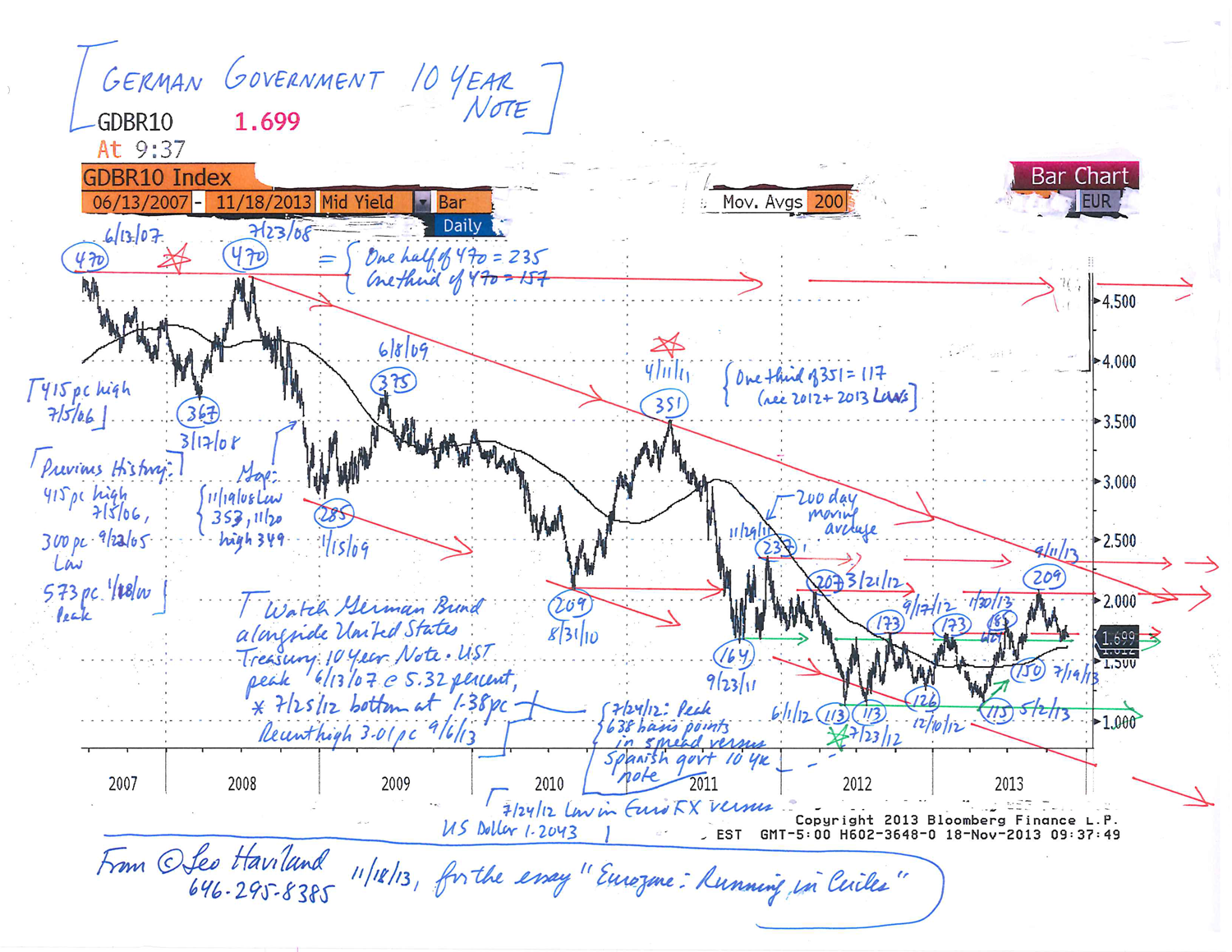
Chart- German Govt 10 Year Note (for essay, Eurozone- Running in Circles) (11-18-13)

JAPAN: FINANCIAL CLIFFS AND CURVES © Leo Haviland November 26, 2012

The major bull charge by the Japanese 10 year government bond (JGB) to lower yields probably ended in late July 2012, or will do so soon. The Japanese Yen’s long run bull trend (effective exchange rate basis, Bank of England data) likewise probably ceased in midsummer 2012.

Four significant inflationary variables have or likely will entangle with the massive Japanese easing to date. First, major central banks around the world via various methods have engaged in extravagant easing. Consider the money printing (QE1, 2, 3), low interest rates, and other accommodative weapons of the United States Federal Reserve. The economic wizards at the Fed have heralded they will not change to a tightening course anytime soon. Don’t forget the European Central Bank’s gradual even if roundabout surrender to easy money principles (especially over the last year). Recall the generous central bankers of China, the United Kingdom, and Switzerland. In the interconnected global economy, the more widespread and sustained the money printing and related policies, the more likely that there eventually will be upward price moves in consumer prices (and similar measures) as well as interest rate increases.

A more specific focus on the Japanese situation reveals the three other considerations. For starters, the Japanese business community (exporters especially) has become extremely upset (not merely worried) by the Yen’s sustained strength. This dismay increased due to a recent noteworthy GDP slump. Business interests (Japan, Inc.) significantly influence Japanese political policies. Second, Japan likely will enshrine a new governing political party after its December 2012 elections. These incoming political leaders apparently seek an even easier monetary policy than presently exists.

The third relates to the towering Japanese government debt and ongoing substantial budget deficits. Most political pundits and marketplace mavens bemoan the looming United States fiscal cliff. Japan, unlike America, wins praise as being a nation of savers (creditors) rather than debtors (borrowers). However, the Japanese government, unlike its citizens, does not incarnate thriftiness.

The current and medium term Japanese fiscal outlook, even without a change in government policies, is no cause for complacency. The Japanese political (economic) establishment, regardless of party, engages in brinkmanship, for it has shown little inclination to subdue that substantial deficit spending and massive and growing government debt. Compare the United States awesome near term and long run federal debt vista. Thus Japan probably already is fairly close to the border of a fiscal crisis. Read the rest of this entry »