

GLOBAL ECONOMICS AND POLITICS

Leo Haviland provides clients with original, provocative, cutting-edge fundamental supply/demand and technical research on major financial marketplaces and trends. He also offers independent consulting and risk management advice.

Haviland’s expertise is macro. He focuses on the intertwining of equity, debt, currency, and commodity arenas, including the political players, regulatory approaches, social factors, and rhetoric that affect them. In a changing and dynamic global economy, Haviland’s mission remains constant – to give timely, value-added marketplace insights and foresights.

Leo Haviland has three decades of experience in the Wall Street trading environment. He has worked for Goldman Sachs, Sempra Energy Trading, and other institutions. In his research and sales career in stock, interest rate, foreign exchange, and commodity battlefields, he has dealt with numerous and diverse financial institutions and individuals. Haviland is a graduate of the University of Chicago (Phi Beta Kappa) and the Cornell Law School.


Subscribe to Leo Haviland’s BLOG to receive updates and new marketplace essays.

RSS View Leo Haviland's LinkedIn profile View Leo Haviland’s profile


SEASONS COME, SEASONS GO: US NATURAL GAS © Leo Haviland February 5, 2019

“The Times They Are A-Changin’”, a Bob Dylan song

CONCLUSION AND OVERVIEW

The vicious bear slump in NYMEX natural gas (nearest futures continuation) that started after 11/14/18’s 4.929 peak probably will end between mid-February and early March 2019. Assuming normal weather for the balance of winter 2019, major support around 2.40/2.50 probably will hold. Above-average temperatures for the rest of this winter increase the risk of a  moderate breach of the 2.40/2.50 floor.

Looking forward over the next several months, NYMEX natural gas (nearest futures) probably will remain in a sideways trend between 2.40/2.50 and 3.20/3.45. However, higher than anticipated United States natural gas production, reduced demand due to milder than expected summer weather, or American economic feebleness may inspire an assault on the lower end of that range. Many important lows in nearest futures continuation have occurred in late August/calendar September.

****

What is a “low”, “high”, or “normal” (average, reasonable) inventory is a matter of opinion. In any case, over the past two years, the United States natural gas industry probably has shifted toward a lower level of desired (appropriate, reasonable, normal, prudent, sufficient) stock holding relative to long run historical averages. Structural changes in the US natural gas marketplace have encouraged more widespread (and more aggressive) adoption of a “just-in-time” (lower inventories in days coverage terms) inventory management approach instead of a “just-in-case” (relatively higher stockpiles) method.

Why? One likely factor has been faith that gas production (in 2018, 2019, and thereafter) would remain far greater than that of calendar 2017. Many players therefore probably believe there “always (or almost always) will be enough gas around” to satisfy demand, even during peak consumption periods. Another variable likely encouraging lower inventory in days coverage terms is the substantial expansion of America’s pipeline infrastructure. Thus it has (will) become easier to move sufficient gas to many locations where it is needed. In addition, the growing share of renewables in total US electricity generation arguably to some extent reduces the amount of necessary natural gas inventories.

****

Assume an entrenched change in natural gas inventory management practices to the just-in-time orientation. Assume also that from the days coverage perspective (stocks relative to consumption), the “reasonable” level of industry holdings has tumbled by several days relative to historical days coverage benchmarks. Nevertheless, anticipated October 2019 (and October 2020) United States natural gas inventories from the days coverage perspective are substantially lower than the historical average. The natural gas inventory situation therefore is somewhat bullish, particularly from the perspective regarding the close of build seasons at end October 2019 and end October 2020.

Suppose US natural gas output does not surpass current expectations, economic growth remains moderate, weather remains normal, and commodity prices in general (especially in the petroleum complex) do not collapse. This natural gas inventory situation, assuming it persists, makes it probable that the marketplace eventually will attack and surpass 3.20/3.45.

Although prospects for US natural gas days coverage at end October 2019 and October 2020 at present currently are fairly bullish, end March 2020 inventories appear sufficient. It consequently may be difficult to sustain moves over 3.45/3.70.

Despite the explosive price leap to nearly 5.000 in mid-November 2018, the shattering collapse from mid-December (12/10/18 high at 4.666), signals that many natural gas marketplace participants probably remain complacent regarding the availability of supplies, even in regard to periods of expected or actual high demand. The current sideways trends and relatively modest price heights for the summer 2019 and winter 2019-2020 calendar strips likewise reflect little worry regarding prospective supply availability 

However, picture a significantly colder than usual winter (or widespread belief this will occur). A colder than normal winter 2019/20 (or winter 2020/21), assuming low end-October days coverage, boosts the risks of very low inventories at the end of winter and thus substantial (even if brief in duration) bull charges. US natural gas inventories were very low in days coverage terms at end-October 2018. Fears that available supplies (whether in days coverage or arithmetical terms) are or may become tight can prompt feverish scrambles to procure them. Recall the spike from 9/10/18’s 2.752 and 10/29/18’s 3.100 up to November 2018’s summit. In any case, the most probable time for any flight toward or above 4.00/4.10 is close to or during winter.

FOLLOW THE LINK BELOW to download this article as a PDF file.
Seasons Come, Seasons Go- US Natural Gas (2-5-19)
US NATURAL GAS: CAUGHT IN THE MIDDLE © Leo Haviland February 1, 2016

“So much trouble in the world…
The way earthly thin’s are goin’
Anything can happen”. Bob Marley and the Wailers, “So Much Trouble in the World”

 ****

CONCLUSION AND OVERVIEW

In economics, politics, and other cultural fields, players create a variety of competing perspectives. They select between and arrange a variety of diverse variables to produce their arguments and conclusions. In commodity, currency, interest rate, and stock marketplaces, bulls and bears therefore tell a variety of contending stories. In natural gas as in other marketplace battlegrounds, an array of speakers creates assorted viewpoints fighting to attract attention and persuade eager audiences.

****


“Dangerous Times in US Natural Gas” (11/2/15) concluded: “The probable range for the United States natural gas marketplace (NYMEX nearest futures continuation basis) for the next several months is a relatively broad avenue between major support at 1.65/1.90 and significant resistance at 3.10/3.45.” The NYMEX natural gas major bear trend that followed 2/24/14’s major peak at 6.493 smashed through 4/27/15’s 2.443 minor low, 10/27/15’s 1.948 interim low, and the last prior major bottom (1.902 on 4/19/12), crashing to 1.684 on 12/18/15. Assuming normal weather for the balance of winter 2015-16 and spring/summer 2016, this range probably will persist for the next several months as well.

The high since December 2015’s low is 1/8/16’s 2.495. What would enable US natural gas prices (nearest futures) to sustain travels over 3.00? It probably will require significantly colder temperatures for the balance of winter, a blazing spring and summer, or (and especially) noteworthy cuts in natural gas production. Stronger than expected US (and global) economic growth would help rally natural gas prices. A major bull move in commodities “in general” (and especially in the petroleum complex) and a significant reversal of the major bull move in the broad real trade-weighted US dollar to some extent would assist a bull move in natural gas.

However, a somewhat significant containment risk (supplies too high relative to available storage capacity), nevertheless exists for US natural gas around the end of calendar 2016 build season. If containment fears grow stronger, and especially if actual problems develop, the 1.65 floor could be broken. In addition, US economic weakness (especially if accompanied by similar slumps around the globe), renewed feebleness in commodities (particularly in the petroleum world), and a continued strong trade-weighted US dollar would help to keep US natural gas prices under pressure.

****

Historical analysis indicates the major bear trend in US natural gas from February 2014 to December 2015 voyaged sufficiently far in price and duration terms to conclude that a trend shift from bearish to sideways occurred with December 2015’s low. However, the dramatic February 2014 to October 2015 price tumble is not the greatest or longest on record. So a further descent in NYMEX natural gas would not be unprecedented.

Anticipated end March 2016 gas inventories probably will be high in both arithmetic (bcf) and days coverage terms, a bearish consideration. However, based upon US Energy Information Administration (EIA) anticipated end October 2016’s 52.1 days coverage level slides 3.4 days beneath the 2006-15 end October average of 55.5 days and 1.5 days under 1990-2015’s 53.6 days.

Nevertheless, modest days coverage levels for October 2016 does not eliminate a containment danger; one should focus closely on arithmetic levels. The days coverage perspective of course does not provide a complete viewpoint on the natural gas inventory situation and related price risks. After all, arithmetic quantities (bcf) of gas must be put in arithmetic storage places. Especially if little new natural gas storage capacity has been (and is being) created, containment problems could emerge around the end of the 2016 inventory build season (roughly around end October 2016). And currently, the containment risks for the end of build season 2016 are not insubstantial; this bearish potentiality weighs on prices.

Yet sustained low natural gas prices could reduce production more than some soothsayers forecast. This would help reduce containment risks. Note the big drop in US natural gas rig counts. A sustained slump back under 2.00 might boost electric power switching from coal to gas.

Everyone knows that much can happen between now and 2017, whether in natural gas or elsewhere. Yet based upon the EIA’s bcf prediction, natural gas days coverage at end October 2017 probably will be less than average, a bullish factor. And the EIA’s bcf arithmetic inventory forecast for end October 2017 implies there probably will not be a containment problem around the end of build season 2017.

****

Natural gas prices often travel substantially independently of both petroleum (and commodities “in general”) and so-called “international” or “financial” marketplaces and variables. Trend changes in NYMEX natural gas need not roughly coincide with one in the petroleum complex or commodities in general, or currency, stock, or interest rate playgrounds.

However, especially since mid-to-late June 2014 (NYMEX natural gas nearest futures interim high 6/16/14 at 4.886) and into calendar 2015 (gas interim top 5/19/15 at 3.105), bearish natural gas price movements intertwined with those in the petroleum complex (and commodities in general) and the bull move in the broad real trade-weighted US dollar. Such natural gas retreats to some extent paralleled slumps in emerging marketplace stocks. Note also the timing coincidence between May 2015’s natural gas top and the S+P 500’s 5/20/15 peak at 2135. In regard to the timing of the S+P 500’s May 2015 high, note that the nominal broad trade-weighted dollar (Federal Reserve, H.10, which has daily data) made an interim low at 112.8 on 5/15/15 before appreciating further.

See “The Curtain Rises: 2016 Marketplace Theaters” (1/4/16), “Japanese Yen: Currency Adventures (2007-09 Revisited)” (1/14/16), “Commodities: Captivating Audiences” (10/12/15), and various related essays.

Natural gas prices indeed can trade “on their own”. But suppose a sustained bull move finally appeared in commodities “in general” (especially petroleum). Worldwide OECD industry and United States petroleum stocks are very elevated. OPEC next meets 6/2/16. It remains determined to capture market share and induce output cutbacks by high-cost oil producers around the world (including some American and Canadian ones). But is crude oil under 30 dollars a barrel “irrational”? The chairman of Saudi Arabia’s state oil company, Aramco said: “’The market has overshot on the low side and it is inevitable that it will start turning up’”, predicting higher prices by the end of the year.” (Financial Times, 1/22/16, p20). Will OPEC reach agreement with non-OPEC nations such as Russia to boost prices? Might OPEC hold an emergency meeting?

Key global central banks battle to ensure economic growth, create sufficient inflation (avoid deflation), and reduce unemployment. The European Central Bank recently suggested it might ease its already highly accommodative policies further (ECB Statement and Press Conference, 1/21/16). The Bank of Japan recently (1/29/16) eased its lax monetary policy even further, adopting negative interest rates. Will the Federal Reserve delay additional interest rate increases?

The Fed and its allies probably do not want the S+P 500 and related stock marketplaces to crash under their January 2016 lows. They also probably do not want the dollar’s bull move to extend much (if at all) beyond its January 2016 high. The US dollar’s major bull trend has been long and powerful. From its July 2011 major low around 80.5 to the recent January 2016 high at 101.2, the broad real trade-weighted dollar has climbed 25.8 percent (Federal Reserve, H.10; monthly average). What will happen to natural gas prices if the S+P 500 (and emerging marketplace stocks “in general”) rallied substantially? What if the US broad real trade-weighted dollar weakens notably (even if it remains relatively strong)?

FOLLOW THE LINK BELOW to download this article as a PDF file.
US Natural Gas- Caught in the Middle (2-1-16)

ROLLIN’ AND TUMBLIN’ IN US NATURAL GAS © Leo Haviland April 20, 2015

In all marketplace battlefields, a wide variety of storytellers select between (and emphasize differently) an array of variables. They thereby generate diverse bullish and bearish arguments that heatedly compete for allegiance and action. And analysis and trading always are difficult enterprises. However, in the United States natural gas universe nowadays, the noise, smoke, and uncertainty produced by these diverse variables and conflicting perspectives and recommendations make it especially challenging to boldly swear unquestioning loyalty to a particular marketplace viewpoint.

What does historical analysis of major United States natural gas bear marketplace moves (NYMEX nearest futures continuation basis) in the context of days coverage reveal regarding the ending of the major bear trend that emerged in late February 2014? Perhaps 4/13/15’s 2.475 low was an important trough; however, several days of course remain in April and many key bottoms have occurred around contract expiration. If a noteworthy bottom is not established in calendar April 2015, the most probable time for a major low is in late August/calendar September 2015. NYMEX natural gas reached many important bottoms in late calendar August and September. However, a final low in late summer 2015 would stretch out the February 2014 bear marketplace trend substantially longer than the historical average.

In any case, if NYMEX natural gas prices pierce 4/13/15’s low (nearest futures continuation), that level probably will not be broken by much. Substantial support lurks around 2.40 and 2.20/2.15.
****

End March 2015’s 20.0 days of coverage (1471bcf divided by about 73.5bcf/day of full calendar year 2014 consumption), though way up from March 2014’s 12.0 days coverage, dips slightly under the 21.8 days end March 1990-2014 average. It also falls a notable, though not extreme, 4.1 days beneath the nine year 2006-14 average. Thus despite the notable arithmetic stock increase during calendar 2014 build season, the national days coverage inventory picture at the end of winter 2014-15 draw season is slightly bullish.

What’s the bottom line in regard to the natural gas bear trend that began in February 2014 if one concentrates on the natural gas inventory variable? With the NYMEX nearest futures natural gas price currently well under 4.00, this end winter 2014-15 inventory factor “taken by itself”, looks neutral to supportive for gas prices. This fundamental consideration should be interpreted alongside the marketplace history relating to price and time factors.

End October 2015’s 49.5 days coverage level slides 6.3 days beneath the 2006-14 end October average of 55.8 days and 4.1 days under 1990-2014’s 53.6 days. This end October 2015 days coverage total therefore is bullish (even if not wildly so given prospects of increased natural gas production).

Look further out in the murky future to March and October 2016. Although much of course can happen between now and then, potential days coverage nevertheless does not suggest notable oversupply relative to historic averages.

The EIA forecasts end March 2016 inventory at 1704bcf and end October 2016 stocks at 3923bcf. Days cover at end March 2016 will be around 22.3 days (1704bcf/76.3bcf/d). Though this is slightly (.5 day) above the 21.8 day 1990-2014 average, it is 1.8 day less than 2006-14’s 24.1 day average. October 2016’s hypothetical days coverage is 51.7 days (3923bcf/75.8bcf/d. This is about 1.9 days under the 1990-2014 average for that calendar month and 4.1 days beneath 2006-14’s 55.8 day average.

FOLLOW THE LINK BELOW to download this article as a PDF file.
Rollin' and Tumblin' in US Natural Gas (4-20-15)

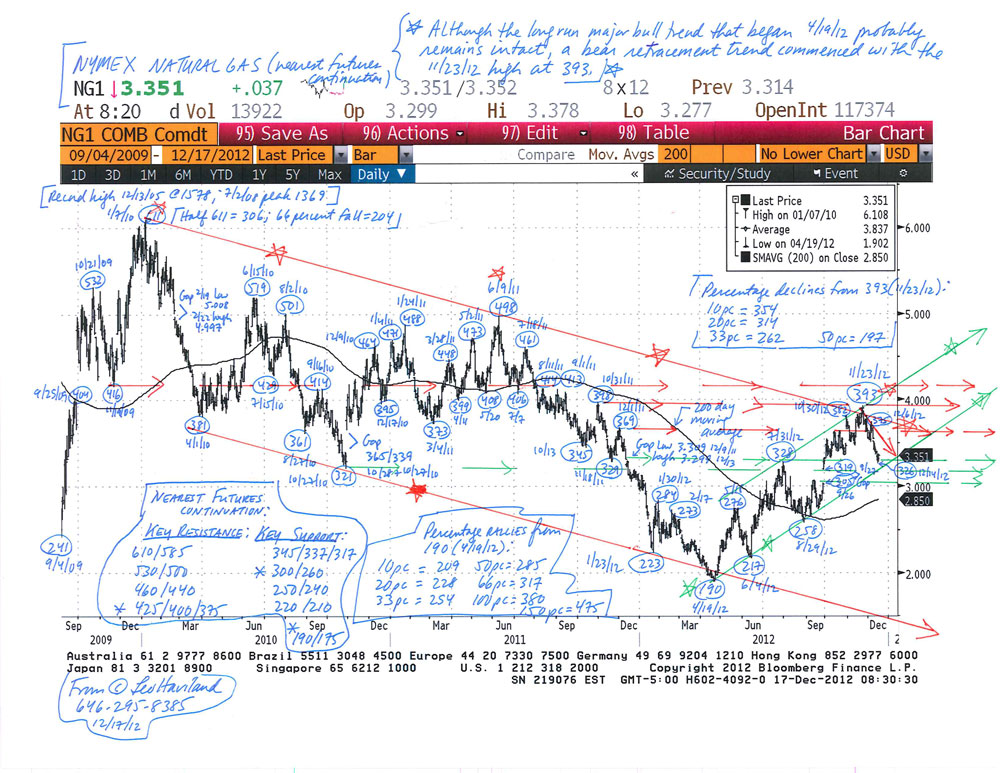
US NATURAL GAS IN WINTER 2012-13: DRAWING CONCLUSIONS © Leo Haviland, December 17, 2012

The current bear trend in US natural gas (NYMEX nearest futures continuation basis) that began in late November 2012 at 393 will continue. Assuming normal cold winter weather, the price probably will slump to around the 300 to 285 range. When will the price quit sledding downhill? Though it may only be an initial significant bottom, look for an important low in calendar January or February 2013, probably around futures expiration.

End October 2012 inventories were around 3923bcf according to the EIA barometer (Short-Term Energy Outlook, December 2012; “STEO”). Therefore end October’s 56.3 days of coverage rest about 2.6 days above the 53.7 day long run (1990-2011) average. Though not a big overload relative to that long run average, it is sufficient to place some burden on prices.

Moreover, look at the likely increasing relative oversupply in days coverage terms versus the 1990-2011 average for the given calendar month as time passes from end October 2012 to end March 2013. At end March 2013, forecast inventories of 1873bcf (December STEO, Table 5a) represent about 26.9 days coverage (1873bcf divided by 69.70bcf/d). This jumps about 4.7 days over the 22.2 day long run average for that month, more than October’s 2.6 days.

Suppose end March 2013 inventories are 1800bcf. The excess relative to the long run average is 3.6 days (25.8 less 22.2). This still hovers above the 2.6 day end October 2012 difference.

Despite the ongoing near term downtrend, and absent another very mild winter akin to 2011-12’s, a NYMEX natural gas price collapse close to the 190 abyss of April 2012 (or even the 1/23/12 and 6/14/12 depths near 220) is unlikely.

Based on 2012’s substantial switching from coal to natural gas, particularly in the electric power territory, natural gas demand probably will mount if prices sustain levels beneath (roughly) 275. In addition, another factor probably will mitigate price declines. Concentrate on days coverage holdings in recent years.

The desired level of natural gas inventory holding in recent years arguably has climbed relative to that long run average. Consequently the oversupply of October 2012 through March 2013 probably is less than many observers believe.

Natural-Gas-Chart-(NYMEX-nearest-futures)-(12-17-12)

FOLLOW THE LINK BELOW to download this market essay as a PDF file.
US Natural Gas in Winter 2012-13- Drawing Conclusions (12-17-12)
Natural Gas Chart (NYMEX nearest futures) (12-17-12)