GLOBAL ECONOMICS AND POLITICS
Leo Haviland provides clients with original, provocative, cutting-edge fundamental supply/demand and technical research on major financial marketplaces and trends. He also offers independent consulting and risk management advice.
Haviland’s expertise is macro. He focuses on the intertwining of equity, debt, currency, and commodity arenas, including the political players, regulatory approaches, social factors, and rhetoric that affect them. In a changing and dynamic global economy, Haviland’s mission remains constant – to give timely, value-added marketplace insights and foresights.
Leo Haviland has three decades of experience in the Wall Street trading environment. He has worked for Goldman Sachs, Sempra Energy Trading, and other institutions. In his research and sales career in stock, interest rate, foreign exchange, and commodity battlefields, he has dealt with numerous and diverse financial institutions and individuals. Haviland is a graduate of the University of Chicago (Phi Beta Kappa) and the Cornell Law School.
Subscribe to Leo Haviland’s BLOG to receive updates and new marketplace essays.

Although China’s economy of course differs from those of other major nations around the globe, it intertwines with them. However, China’s huge debt securities marketplace receives relatively little attention from traders, analysts, and the media in comparison to those of the United States, the Euro Area, and Japan.
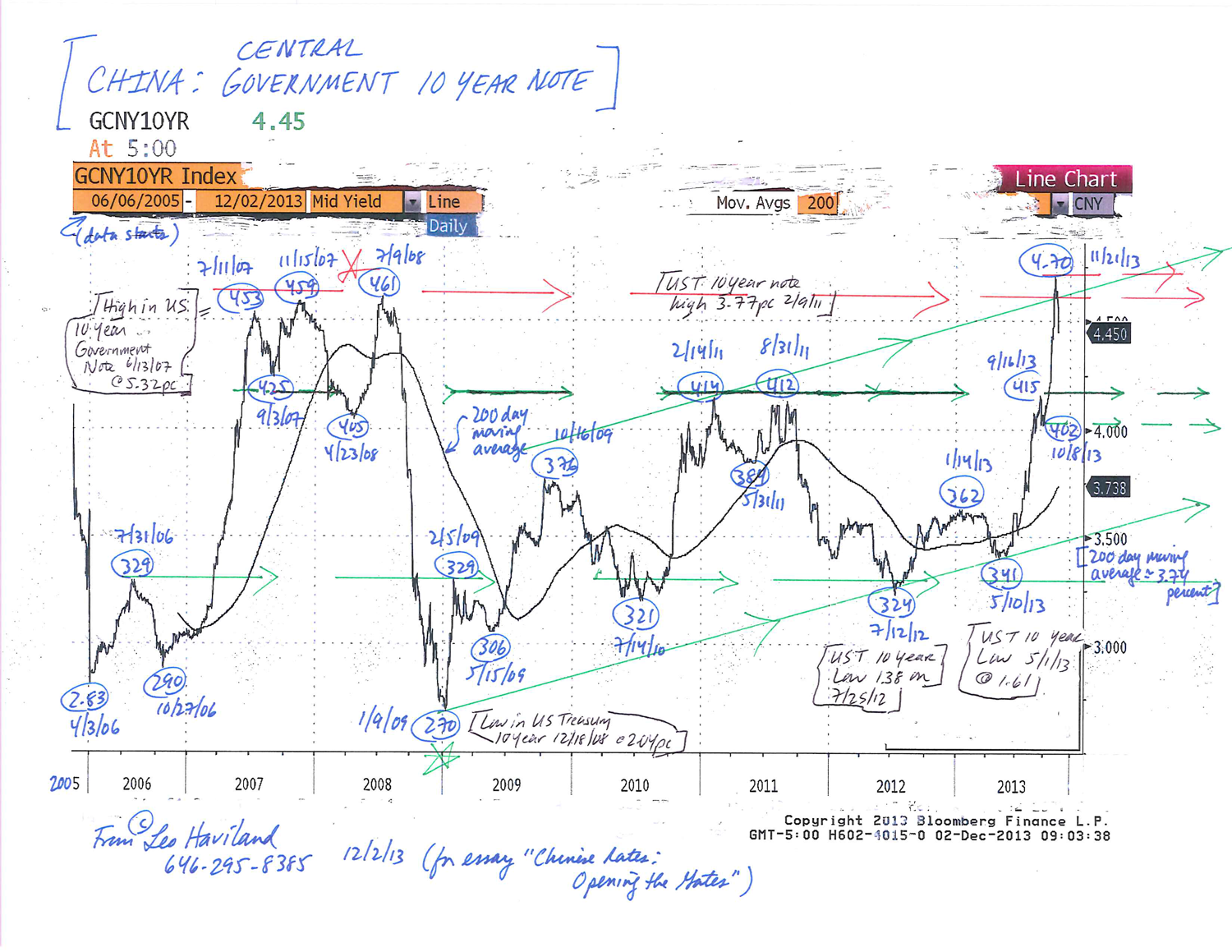
Debt, stock, currency, and commodity marketplace observers concentrating on matters such as Federal Reserve Board policy and the S+P 500’s level and trend should extend their vision to include Chinese interest rates. China’s 10 year government note, after establishing bottoms at 3.24 percent on 7/12/12 and 3.41pc on 5/10/13, has raced higher. After a brief stop at 4.02pc on 10/8/13, the note decisively crashed through 2011’s 4.10pc barrier, recently breaking through 2007-08’s wall around 4.60pc to reach its recent high of 4.70pc on 11/21/13. The one year government note yield likewise has ascended significantly. Chinese government interest rates probably will continue to climb higher.
Near-universal optimism reigns regarding China’s economic situation and prospects. Even if the national economy is relatively robust, it may be less so than many believe.
Given China’s obvious importance to the world economy, a greater than expected slowdown in the marvelous Chinese growth rate, in part due to sustained higher yields, probably would entangle with and undermine recovery prospects in other territories. Moreover, since the end of the joyous Goldilocks Era and during the dreadful international economic crisis and the subsequent recovery, many turning points in the 10 year Chinese government note have occurred around the same time as those in benchmark 10 year US Treasury and German government notes. Thus despite the yield repression policy tightly embraced by the Federal Reserve and its central banking allies, the notable ascent in Chinese government interest rate yields underlines that the overall long run trend for yields in most key nations is probably higher.
FOLLOW THE LINK BELOW to download this market essay as a PDF file.
Chinese Rates- Opening the Gates (12-2-13)
Chart- Chinese Government 10 Year Note (for essay, Chinese Rates- Opening the Gates) (12-2-13)
The United States real estate marketplace, despite some improvement relative to winter 2008-09’s abyss, remains in mournful shape. During the ongoing terrible global economic crisis, nervous politicians, fearful central bankers, and enthusiastic real estate business promoters have devoted much effort and creativity in their quest to rescue the real estate arena. How should we characterize their overall performance to date? Despite their numerous at-bats and vigorous swings at the real estate debacle, the financial and political guardians have often struck out and their overall batting average remains low.
Perhaps the real estate scene will become brighter. After all, central bankers and politicians always have upcoming opportunities to step up to the plate. They will keep swinging and whacking at real estate problems. Nevertheless, the still-feeble US real estate world underlines the fragile foundation and structure of the economic revival fabricated by the Federal Reserve (and its overseas central bank teammates) and political crews. Despite some progress, the shattering damage of the international economic disaster that commenced in 2007 has not been substantially fixed. The economic crisis persists and will continue for several more innings. Though the worldwide economic advance that emerged in spring 2009 reflects repairs and is not entirely a house of cards, it’s not entirely built on solid ground. Money printing and deficit spending are not genuine (enduring) cures for economic problems.
The recent slowdown in the overall economic landscape will hinder the US real estate recovery. Therefore American real estate prices will remain relatively weak.
FOLLOW THE LINK BELOW to download this market essay as a PDF file.
Still Swamped – US Real Estate (10-11-11)
Yet despite these economic rescue and repair programs, the continued substantial overall weakness in the US real estate marketplace reflects and warns of trouble. In particular, what do the housing sector and its consequences for the consumer balance sheet suggest? One should view real estate in the context of consumer confidence. The foundation for and structure of the recovery fabricated by the homespun policies of the Fed and the political herd is fragile. Although progress has been made, the shattering damage of the international economic disaster that commenced in 2007 has not been fixed. Though the worldwide economic recovery that emerged in spring 2009 is not entirely a house of cards, it’s also not entirely built on solid ground.
Nominal GDP growth is better than none at all, right? All else equal, money printing does not over time breed permanent real GDP growth. Also, deficit spending borrows from the future to spend in the present; it may boost current output, but at the end of the day, this factor primarily involves a shift of money between players and across time. All else equal, even if a slump in the broad real US trade weighted dollar benefits the US economy, that tends to undermine those of many of its trading partners. Holding policy interest rates such as Fed Funds low does not preclude higher yields later. Don’t those substantially in debt or suffering injury to their net worth often endorse easy money policies? Despite optimism indicated by rosy prices in the S+P 500 and lofty corporate profits, US real economic growth probably will be mediocre looking forward from now. What happens to American real estate still matters a great deal for the global economy.
Given the still-weak home and commercial real estate marketplaces, the net worth of many banking institutions probably is vulnerable to marking-to-market of existing real estate loan portfolios. Renewed economic weakness of course would worsen that problem. In any event, banks nervous about their capital strength will not hurry to significantly expand their overall lending.
FOLLOW THE LINK BELOW to download this market essay as a PDF file.
American Real Estate (The Money Jungle, Part Two)
Past and future money printing by the Federal Reserve alongside sustained low interest rates dreams of promoting real economic growth. Central to the imaginative quest is a vigorous effort to rally real equity prices and real real estate prices (especially homes). However, these economic guardians and their allies will settle for nominal GDP increases and nominal rallies in stocks and real estate. What is one key reason? The American consumer is the foundation of the United States economy, and its balance sheet still needs repair in nominal terms.
FOLLOW THE LINK BELOW to download this market essay as a PDF file.
Desperate Housewives (Episode 2)- The Home Front


 View Leo Haviland’s profile