GLOBAL ECONOMICS AND POLITICS
Leo Haviland provides clients with original, provocative, cutting-edge fundamental supply/demand and technical research on major financial marketplaces and trends. He also offers independent consulting and risk management advice.
Haviland’s expertise is macro. He focuses on the intertwining of equity, debt, currency, and commodity arenas, including the political players, regulatory approaches, social factors, and rhetoric that affect them. In a changing and dynamic global economy, Haviland’s mission remains constant – to give timely, value-added marketplace insights and foresights.
Leo Haviland has three decades of experience in the Wall Street trading environment. He has worked for Goldman Sachs, Sempra Energy Trading, and other institutions. In his research and sales career in stock, interest rate, foreign exchange, and commodity battlefields, he has dealt with numerous and diverse financial institutions and individuals. Haviland is a graduate of the University of Chicago (Phi Beta Kappa) and the Cornell Law School.
Subscribe to Leo Haviland’s BLOG to receive updates and new marketplace essays.

The long-running bull charge in the broad real trade-weighted United States dollar, and particularly its recent assault on major resistance established in March 2009, played a critical role not only in creating and sustaining emerging stock (and commodity) marketplace bear moves, but also in the recent bloody toppling of the once-mighty S+P 500 from its lofty May 2015 record peak. Interest rate levels and trends of course remain important to stock marketplace battlefields, but US dollar movements will maintain their substantial influence. The broad real trade-weighted dollar probably will remain relatively strong.
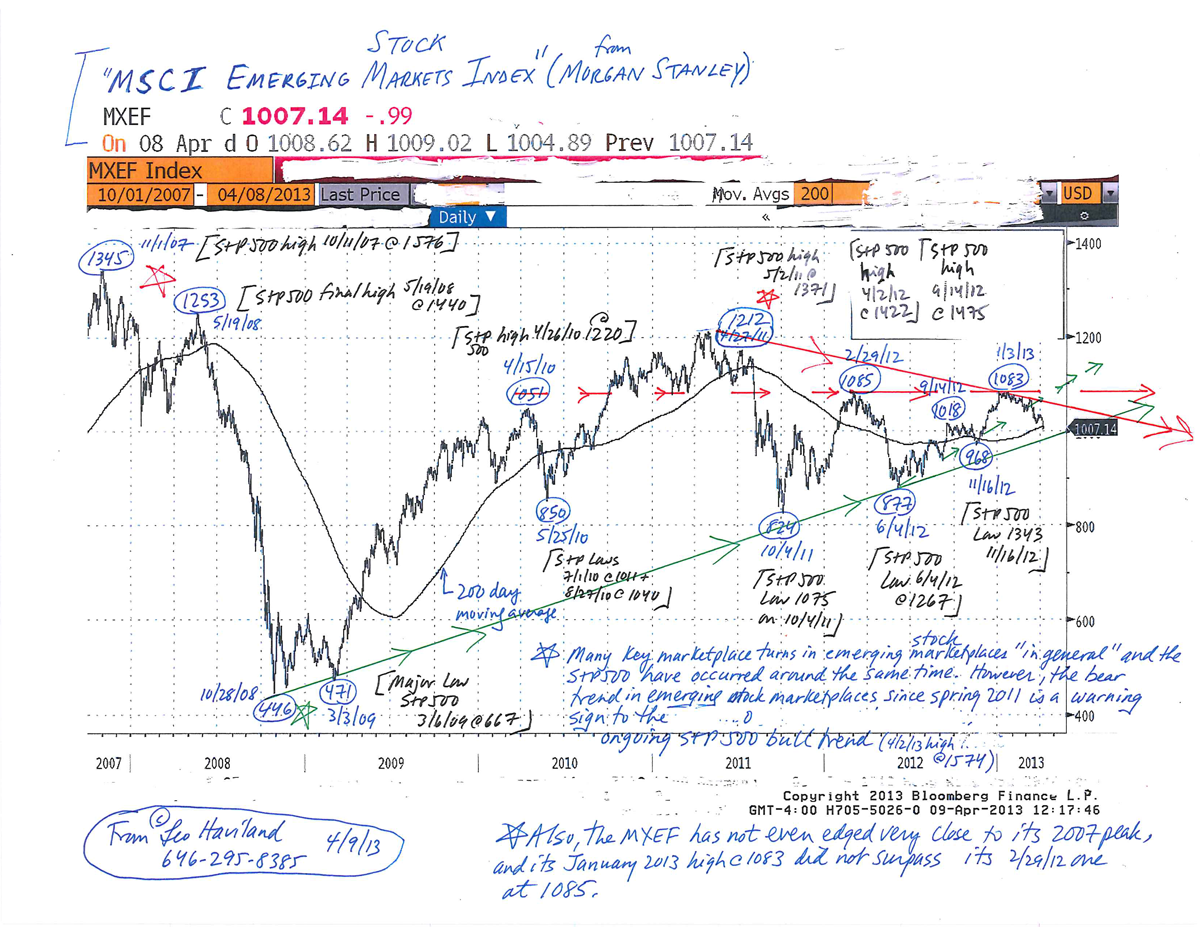
Moreover, the S+P 500’s decline since its 5/20/15 pinnacle at 2135 indicates that its major trend probably will no longer diverge as significantly from those of emerging equity marketplaces. Compare the pattern of the past few years, during which the S+P 500 exceeded its spring 2011 peak but emerging stock marketplaces in general (Morgan Stanley’s MSCI Emerging Stock Marketplace Index benchmark) did not. The S+P 500 probably will not surpass its May 2015 height by much (if at all); instead, it probably will continue to travel lower.
As “Shakin’ All Over: Marketplace Fears”; 8/13/15) noted: “Despite about seven years of highly accommodative monetary policies such as yield repression and money printing (and frequently bolstered by hefty deficit spending), the foundations of worldwide growth increasingly look shaky.” Substantial debt and leverage problems continue to confront today’s interconnected global economy. The Federal Reserve Board of course focuses on all sorts of domestic and international factors and their interrelations. However, nowadays the level and trend of the S+P 500 will continue to strongly influence its policy rhetoric and decisions.
****
What’s the bottom line? Reviewing these various US and diverse international stock marketplace scorecards together, spring 2015’s similar time for highs followed by significant price declines is noteworthy. This underlines the likely slowing of worldwide growth in general. It also shows that stock trend benchmarks for America are nowadays rather closely connected to those elsewhere, including emerging marketplaces. The similar timing of lows in August 2015 emphasizes that worldwide equities in general currently are “trading together”. Renewed roughly simultaneous retreats in emerging and advanced nation stock benchmarks would be an ominous sign to equity bulls and for world GDP growth rates.
FOLLOW THE LINK BELOW to download this article as a PDF file.
Wall Street Marketplace Violence (9-1-15)
Industrial metals such as copper and aluminum of course have different supply/demand fundamentals. They intertwine in diverse ways with significant movements in interest rate and currencies, especially the United States dollar. The overall base metals complex often travels in the same fashion (direction) as precious metals. Yet focus on global stock marketplaces in relation to base metals “in general”. Significantly, from the later stages of the glorious Goldilocks Era to its dreadful decline, from the ensuing worldwide recovery up to the present, trends in base metals “in general” very often show the way or confirm trends in key global stock marketplaces.
Price trends in base metals indeed have been closely tied to the China growth story. Yet significant marketplace trend changes in base metals also fit those in emerging stock marketplaces as a whole. The voyage of the base metals complex since roughly mid to late 2007 closely resembles that of emerging marketplaces “in general”. What about in relation to America’s S+P 500? Since its high on 2/14/11 at 4478, the London Metal Exchange base metal index (“LMEX”) has been in a massive bear trend, falling about 35.0 percent to its 6./24/13 low. In contrast, the S+P 500’s glittering advance has continued up to a 1730 high on 9/19/13. But as before 2011, the timing of the S+P 500’s turning points from 2011 to the present in its overall upward climb generally fit rather closely to those in the LMEX index.
The sustained decline in the base metals battleground “in general” since first quarter 2011 continues to signal slower growth in emerging marketplaces in general and in China in particular. Note the continued lowering of growth estimates for China in recent months. In addition, despite the overall directional price trend divergence between the LMEX and the S+P 500, the sustained base metal weakness warns that growth probably will be weak in advanced nations, and that the glowing strength in the S+P 500 will not be eternal.
Read the rest of this entry »
From the end of the Goldilocks Era in mid-2007 to the depths of the worldwide economic crisis in late 2008 and early 2009 and onward through the ensuing global recovery up to now, “overall” emerging stock marketplaces and commodities “in general” generally have traveled together. The emerging stock marketplace and commodities domains have been in a sideways to bearish trend since their spring 2011 peaks. In the wake of Federal Reserve Board tapering talk, they established interim lows in late June 2013. Yet despite the notable rally since then, in recent weeks they probably have resumed their interrelated downtrends. These bear moves probably will continue. Within the commodities realm, the tumble of the petroleum complex is especially noteworthy.
The bull and bear adventures and timing relationships between emerging stocks and the broad GSCI are not perfect. However, in recent years they have been rather close. Since the peaks in spring 2011, note the pattern of lower and lower highs as the downtrends have proceeded.
Petroleum constitutes an important part of the broad GSCI and many other commodity indices. The petroleum story and its supply/demand situation are important components for the emerging marketplace growth theme. However, note the late summer 2013 reversal of the petroleum bull move that began around a late June 2013 take-off point. In addition, the overall worldwide petroleum situation is bearish. Weakness in various corners of the oil marketplace in recent weeks suggests that commodities “in general” probably will continue to venture lower over the next few months. So what does the historically close association between trends in emerging stock marketplaces and commodities in general suggest? The renewed bear trend in petroleum since late summer 2013 indicates that the MXEF will continue to drift lower as well.
Read the rest of this entry »
Many wizards praise emerging marketplace countries such as China as engines for international prosperity. The worldwide scope of the 2007 financial (economic) crisis and the following years emphasizes the close interconnection of the economies of advanced nations and key emerging (developing) countries around the globe. Historical review from the dawn of the global economic disaster up to the current time reveals price and time parallels between the trends of emerging stock marketplaces and those of the US (and related stock arenas in Europe and other advanced nations). Therefore, the bear trend since spring 2011 in emerging marketplaces is a warning sign to the S+P 500.
Maybe emerging stock marketplaces will resume their bull trend alongside a continuing climb by the S+P 500. However, the downturn within this flock of emerging countries is widespread. Note also the similar fall in commodity prices in general. Such considerations indicate that a return to the bull side by stock marketplaces of emerging marketplaces in general is unlikely. Although relative to their dismal appearance of autumn2008/winter2009, emerging marketplaces may seem to be in full flower (“still looking pretty good”), their bloom has faded substantially and suggests potential for further withering. Not only have stock benchmarks of developing nations in general been a bear trend, but also they established additional interim tops in early 2013. This underlines the significant potential for a notable decline in the S+P 500 in the relatively near future.
FOLLOW THE LINK BELOW to download this market essay as a PDF file.
Chart- Emerging Stock Marketplaces (4-9-13)
Springing a Question- Are Emerging Stock Marketplaces in Bloom (4-9-13)


 View Leo Haviland’s profile