GLOBAL ECONOMICS AND POLITICS
Leo Haviland provides clients with original, provocative, cutting-edge fundamental supply/demand and technical research on major financial marketplaces and trends. He also offers independent consulting and risk management advice.
Haviland’s expertise is macro. He focuses on the intertwining of equity, debt, currency, and commodity arenas, including the political players, regulatory approaches, social factors, and rhetoric that affect them. In a changing and dynamic global economy, Haviland’s mission remains constant – to give timely, value-added marketplace insights and foresights.
Leo Haviland has three decades of experience in the Wall Street trading environment. He has worked for Goldman Sachs, Sempra Energy Trading, and other institutions. In his research and sales career in stock, interest rate, foreign exchange, and commodity battlefields, he has dealt with numerous and diverse financial institutions and individuals. Haviland is a graduate of the University of Chicago (Phi Beta Kappa) and the Cornell Law School.
Subscribe to Leo Haviland’s BLOG to receive updates and new marketplace essays.

“Honest to goodness, the tears have been falling
All over this country’s face
It was better before, before they voted for What’s-His-Name
This was supposed to be the new world…
All we need is money
Just give us what you can spare”. X the Band’s 1983 song, “The New World”
****
Financial observers often seek to ascertain a relationship between apparent trends involving stock, interest rate, currency, and commodity marketplaces. This involves subjective historical reviews as to the extent to which the price and time trends (patterns) of two or more marketplaces tend to converge or diverge. Some viewpoints may indicate that trends for a given marketplace tend to lead (or lag) those of another. For example, people investigate linkages between two United States technology stocks. Or, traders and analysts seek to establish the relationship (extent of convergence or divergence) between emerging marketplace stocks “in general” and the S+P 500.
The marketplace arenas studied are not necessarily the same. To what extent do significant increases in United States Treasury interest rates precede (lead to) eventual noteworthy declines in the S+P 500?
****
Since cultural (subjective) perspectives, arguments, predictions, and actions regarding marketplace and other phenomena and their interrelations diverge (and converge) to various extents over time, emerging stock marketplaces “as a whole” and the S+P 500 do not necessarily trade identically or even very closely in price direction and timing terms. Of course marketplace history is not marketplace destiny, either completely or partially. Relationships within and between financial fields can shift or transform, sometimes dramatically. And these stock theaters have their own supply/demand situations and intertwine with other financial realms and assorted variables in diverse ways. However, over the past couple of decades, important price highs (and lows) and related trend shifts for the overall emerging stock marketplace and the S+P 500 have tended to occur at around the same time, sometimes within a few days, generally within a couple of months.
In first quarter 2020, prices for emerging stock marketplaces began to fall shortly before the S+P 500. They thereafter collapsed and reached a major bottom “together” in late March 2020. Over subsequent months, ferocious bull moves emerged in both districts.
However, since around early March 2021, prices for emerging stock marketplaces have diverged somewhat from the S+P 500. The emerging stock theater stands around seven percent beneath its mid-February 2021 top, whereas the S+P 500 has marched relentlessly to record heights. Will this divergence persist for an extended period?
FOLLOW THE LINK BELOW to download this article as a PDF file.
Financial Marketplaces- Convergence and Divergence Stories (4-6-21)
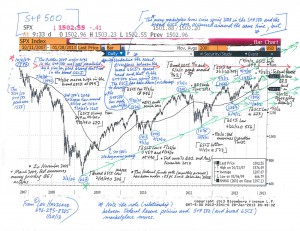
Since mid-2008, commodities “in general” and United States stocks “as a whole” have moved roughly in the same direction at around the same time. In this convergence process (relationship), noteworthy bull (bear) moves in US equities find parallels in those in the commodity arena. Thus significant marketplace rallies (declines) have tended to occur around the same time.
However, this perspective is not the only vantage point by which to assess the often close relationship between US equities and the commodities complex. There also is another, longer run view by which one can examine the relationship between them. Since spring 2011, commodities have ventured down (or sideways to down). However, key American stock benchmarks such as the S+P 500 have attained new highs, first in April 2012, then September 2012, and again in January 2013. Thus despite the convergence at assorted timely turning points since spring/ summer 2008, and even though the two territories continue to trade together to some extent, arguably there has been noteworthy divergence in their overall relationships (their trends) since May 2011.
Now recall several of 2007-08’s details. US equities peaked in October 2007, almost nine months before the commodity one in early summer 2008. Only after the final stock marketplace
summit in May 2008 did equities and commodities trade in close tandem. The current longer run relationship thus perhaps likewise reveals divergence, but with the commodity peak to date appearing well before any major S+P 500 one.
In contrast to 2007-08, what if the major peak in commodities is well before that in stocks (and the lag is likewise so great as to suggest divergence)? Suppose- and this admittedly is a key suppose- eventually commodities and US stocks will trade together over the long run. After all, so-called marketplace relationships can change dramatically, whether from the convergence/ divergence (lead/lag) perspective or otherwise. What does continued divergence, the failure of commodities to near or exceed its spring 2011 heights, suggest?
The 2007-08 relationship warns that the current continued failure of commodities to confirm the equity rally eventually will reveal a notable decline in stocks. Since the duration between the spring 2011 commodities top and today’s new highs in the S+P 500 is almost 20 months, whereas that between October 2007’s stock pinnacle and the broad GSCI’s summit in July 2008 was about nine months, the failure of the broad GSCI to achieve new heights should warn equity bulls that a decline may be fairly near in time.
FOLLOW THE LINK BELOW to download this market essay as a PDF file.
Commodities and US Stocks- Convergence and Divergence (1-28-13)
S+P 500 Chart (1-28-13, for essay on Commodities and US Stocks)


 View Leo Haviland’s profile