

GLOBAL ECONOMICS AND POLITICS

Leo Haviland provides clients with original, provocative, cutting-edge fundamental supply/demand and technical research on major financial marketplaces and trends. He also offers independent consulting and risk management advice.

Haviland’s expertise is macro. He focuses on the intertwining of equity, debt, currency, and commodity arenas, including the political players, regulatory approaches, social factors, and rhetoric that affect them. In a changing and dynamic global economy, Haviland’s mission remains constant – to give timely, value-added marketplace insights and foresights.

Leo Haviland has three decades of experience in the Wall Street trading environment. He has worked for Goldman Sachs, Sempra Energy Trading, and other institutions. In his research and sales career in stock, interest rate, foreign exchange, and commodity battlefields, he has dealt with numerous and diverse financial institutions and individuals. Haviland is a graduate of the University of Chicago (Phi Beta Kappa) and the Cornell Law School.


Subscribe to Leo Haviland’s BLOG to receive updates and new marketplace essays.

RSS View Leo Haviland's LinkedIn profile View Leo Haviland’s profile


AS THE WORLD BURNS: MARKETPLACES AND CENTRAL BANKS © Leo Haviland February 8, 2016

“To every thing there is a season, and a time to every purpose under the heaven.” Ecclesiastes, Chapter 3, verse 1 (King James Version)

****

OVERVIEW AND CONCLUSION

To spark and sustain the worldwide economic recovery that began around first half 2009, the Federal Reserve Board and other major central banks warmly embraced highly accommodative monetary policies such as yield repression and money printing (quantitative easing). Who would want to repeat the horrors of the hellish worldwide economic disaster that erupted in 2007 and worsened dramatically after mid-year 2008? Therefore, often in recent years, after significant hints of feeble growth (or recession) or insufficient inflation (or signs of that evil, deflation) appeared, these high priests of the economic system offered further rhetoric or additional (or new) action to accomplish their aims and restore confidence. Such central banking efforts often succeeded. In any case, financial congregations (especially in American and other stock marketplaces) generally loudly hoped for, fervently encouraged, and joyfully praised such central bank rescue efforts.

However, around mid-2015, advanced nation stock benchmarks such as the S+P 500 peaked. Moreover, despite central bank wordplay and vigorous policy action, bear moves in these stock domains have persisted alongside renewed signs of economic weakness and “too low” inflation. Ongoing collapses in emerging marketplace stocks “in general”, the major bear move in commodities in general, and falling yields in the 10 year United States Treasury note accompanied tumbles in the S+P 500 and other advanced nation equities. The major bull move in the broad, real trade-weighted US dollar, which began in July 2011, has played a key role in these intertwined trends.

In the past few weeks, key global central banks once again preached sermons or engaged in actions aimed not only at creating sufficient inflation (defeating deflation) and ensuring sustained economic recovery. Stock marketplaces initially ascended higher after these recent efforts (recall their lows around January 20, 2016), and the US dollar weakened somewhat. The Federal Reserve Board and other guardian angels probably did not want the S+P 500 and related stock marketplaces to crash under their January 2016 lows. In addition, they probably did not want the United States dollar bull move to extend much (if at all) beyond its January 2016 high.

However, and although not much time has passed since these recent ardent central bank efforts, the S+P 500 and other stock landmarks have resumed their slumps. Ominously, many stock marketplaces have fallen under their August/September 2015 lows. In addition, the dollar still remains strong, commodities weak (despite talk about and hopes for OPEC petroleum production cuts), and US government yields (in a flight to quality) depressed. This vista warns that the Fed and other revered central banks are finding it more and more difficult to accomplish their various policy aims. It suggests that people (including devoted investors in US stocks) increasingly are losing faith in the ability of central banks to produce desirable outcomes.

Although it is a difficult marketplace call, these ongoing and interwoven marketplace trends probably will continue for a while longer. Admittedly, if these marketplace patterns persist and especially if they extend, watchers should beware of even more dramatic (and perhaps coordinated) central bank rescue action.

****

For additional currency, stock, interest rate, and commodity marketplace analysis, see essays such as “The Curtain Rises: 2016 Marketplace Theaters” (1/4/16), “Japanese Yen: Currency Adventures (2007-09 Revisited)” (1/14/16), “US Natural Gas” Caught in the Middle” (especially pp2-3), “America: A House Divided” (12/7/15), “Two-Stepping: US Government Securities” (12/1/16), “Commodities: Captivating Audiences” (10/12/15), and “Déjà Vu (Encore): US Marketplace History” (10/4/15).

FOLLOW THE LINK BELOW to download this article as a PDF file.
As the World Burns- Marketplaces and Central Banks (2-8-16)
INFLATION HOPES, DEFLATION FEARS, MARKETPLACE SIGNS © Leo Haviland January 20, 2014

In the current environment, many central bankers in so-called advanced nations such as the US, Europe, Japan, and the United Kingdom (and in many other places around the globe) have adopted an inflation ideology. The IMF’s leading light heralds in her speech: “With inflation running below many central banks’ targets, we see rising risks of deflation, which could prove disastrous for the recovery. If inflation is the genie, then deflation is the ogre that must be fought decisively.” For OECD-type (advanced) countries, one can summarize the current version of that beloved doctrine: “moderate inflation of around two percent is good, lower than that is not very good (or maybe even a little bit bad), and deflation is definitely bad.” It is unclear how much inflation (in the opinion of marketplace generals these days) would be inappropriate (bad), but arguably over five percent on a sustained basis definitely would be bad (evil; monstrous).

Suppose worldwide deflationary forces remain very significant. Perhaps credit (and debt) and leverage problems developed during the Goldilocks Era (and probably during quite a few years before then) have not been solved. Suppose the worldwide economic crisis that emerged in 2007 and accelerated in 2008 did not create sufficient deflation to remedy the inflationary issues previously built up. Then lax monetary policy at best (even if accompanied by substantial deficit spending) may create mediocre real economic growth, generate less than desired (sufficient) inflation, and only modestly improve the dismal unemployment picture.

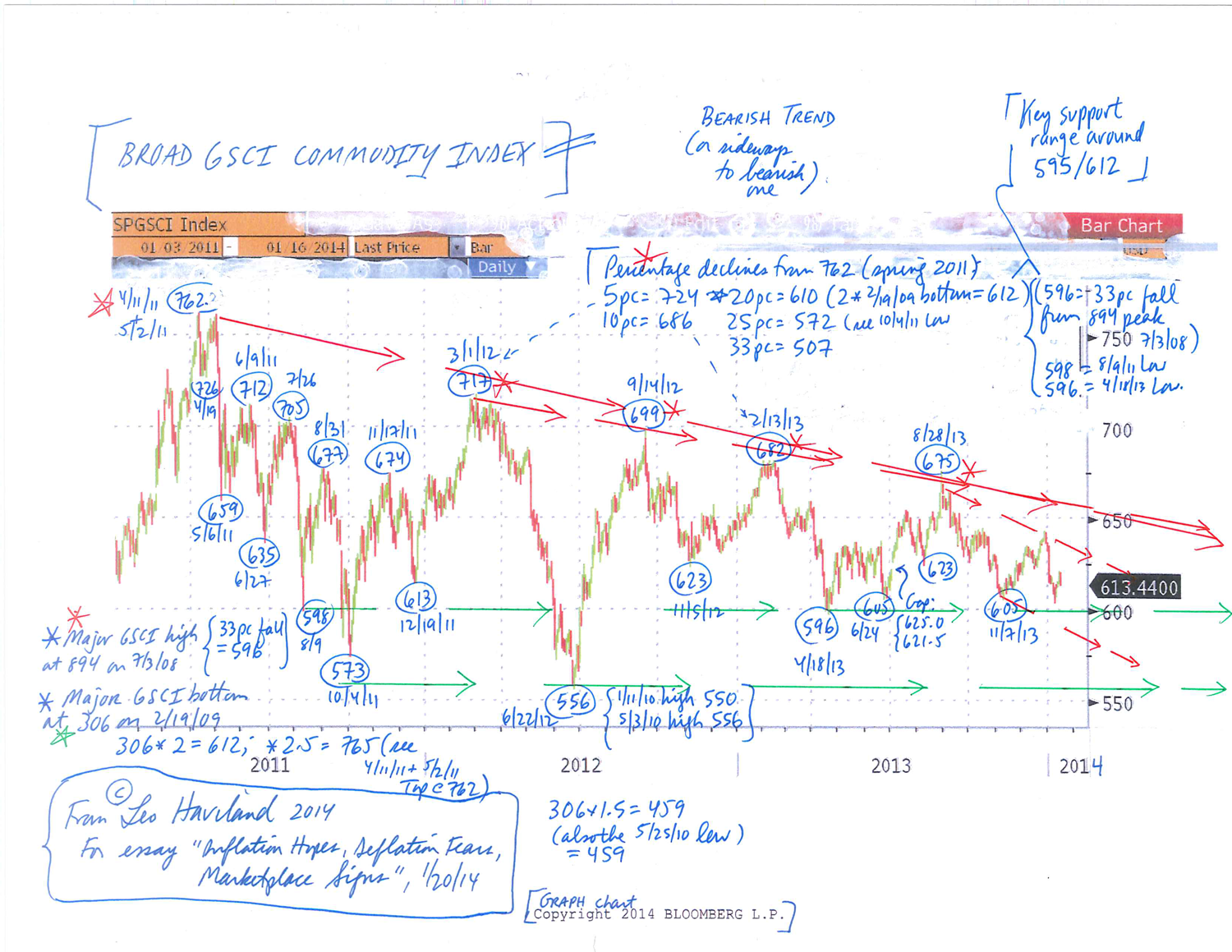
The trends of recent years show declines in real US median (and mean) income. Commodities have been in a downtrend since their peaks in spring 2011. Of course commodities are only one part of consumer price indices. And wages and incomes are not the same as consumer prices. Yet these trends in US income and the broad GSCI indicate that “inflation in general” (including such measures as the consumer price index, PCE, and GDP deflator) is strongly entrenched at low levels. In addition, unless the Fed and other central banks embark on even more massive easing than they have done thus far, this income and commodity evidence (especially when interpreted alongside the low rates of CPI-type inflation) suggests that it probably will be very difficult for “inflation in general” to rise much if at all from current low levels. And “very low” inflation (or even deflation) eventually may appear outside of the real income and commodity territories (especially if US and related interest rates leap higher).

In any event, the US income statistics and broad GSCI bear trend indicate that despite all the Fed (and other central bank) easing, the creation of sustained “sufficient” consumer price (or PCE) inflation remains a huge challenge. Given the intertwining of inflation policies and phenomena (and forecasts) with those of real GDP and unemployment, these notable wage and commodity trends hint that real GDP increases probably will be less than regulators and politicians (not just in the US) aim for, and that unemployment probably will not fall as much as desired.

Chart--Broad-GSCI-(for-essay,-Inflation-Hopes,-Deflation-Fears...)-(1-20-14)

FOLLOW THE LINK BELOW to download this market essay as a PDF file.
Inflation Hopes, Deflation Fears, Marketplace Signs (1-20-14)
Chart- Broad GSCI (for essay, Inflation Hopes, Deflation Fears…) (1-20-14)