GLOBAL ECONOMICS AND POLITICS
Leo Haviland provides clients with original, provocative, cutting-edge fundamental supply/demand and technical research on major financial marketplaces and trends. He also offers independent consulting and risk management advice.
Haviland’s expertise is macro. He focuses on the intertwining of equity, debt, currency, and commodity arenas, including the political players, regulatory approaches, social factors, and rhetoric that affect them. In a changing and dynamic global economy, Haviland’s mission remains constant – to give timely, value-added marketplace insights and foresights.
Leo Haviland has three decades of experience in the Wall Street trading environment. He has worked for Goldman Sachs, Sempra Energy Trading, and other institutions. In his research and sales career in stock, interest rate, foreign exchange, and commodity battlefields, he has dealt with numerous and diverse financial institutions and individuals. Haviland is a graduate of the University of Chicago (Phi Beta Kappa) and the Cornell Law School.
Subscribe to Leo Haviland’s BLOG to receive updates and new marketplace essays.

The broad real trade-weighted United States dollar probably will remain weak. Continuing its major long run bear trend from its March 2009 high, it probably will challenge its record low of July 2011. Why?
Among assorted bearish factors, focus on two which are becoming increasingly significant. First, the Federal Reserve Board in its September 2013 meeting displayed its absence of a genuine forward guidance plan and a lack of an authentic comprehensive exit strategy. Thus marketplace faith in the Fed has declined and will do so further in the aftermath of that September gathering. Keep in mind that feeble (vague) Fed guidance and decreased confidence in the Fed occurs amidst ongoing (and long-running) gigantic money printing and interest rate repression. The central bank is doggedly determined to keep pinning the Federal Funds rate near the floor (and thus below current inflation rates and announced Fed inflation targets) for some time. So how attractive are and will be United States Treasury yields for much over much of the government yield curve? Second, America’s national political players currently display weak fiscal (economic) leadership, especially as the debt ceiling limit beckons.
The Federal Reserve Board’s overall exit strategy for its extraordinary sustained accommodative policy remains far more a sketch than a complete design or coherent practical plan. Prior to its September 2013 assembly, central bank communicators strongly hinted the Fed soon would reduce its massive money printing campaign. Yet the illustrious Federal Reserve Board generals surprised the great majority of observers by not cutting back on quantitative easing. Moreover, these Fed luminaries also underlined their flexible attentiveness to a wide array of intertwining variables which will influence their tapering and other decisions. The ever-watchful Fed thus implicitly demonstrated that its loudly-proclaimed forward guidance wordplay offers Fed watchers at best only modest enlightenment and direction. America’s central bank consequently did more than increase marketplace uncertainty. The Fed wounded its own marketplace credibility. By damaging its credibility, the Fed reduces the widespread belief that it can engineer or at least significantly influence “good” economic outcomes.
Unfortunately, the significant shortfall in forward guidance from the guiding lights at the Federal Reserve currently coincides with a badly fractured American national political scene. Of course politicians and parties disagree and compete vigorously. Yet in the United States in recent years, significant philosophical divisions, diverse and often well-entrenched interests, and quests by political players to capture attention and win elections have combined to create ongoing “overall” feeble national political leadership. Strong political individuals in combination do not necessary make a strong collective group.
Failing to satisfactorily resolve the funding and (especially) the debt ceiling issues (and related deficit spending questions) will call in question America’s political leadership as a whole. All else equal, growing doubts about the quality of that leadership (and related fiscal policies) tend to undermine confidence in the US dollar. Besides these current feuds, America’s national political leaders continue to make no progress in resolving or even significantly mitigating the country’s looming long run fiscal deficit problem. Debt crises do not occur only in emerging or developing nations or in countries on the European “periphery”.
FOLLOW THE LINK BELOW to download this market essay as a PDF file.
Forward Guidance and the US Dollar (9-23-13)
The world’s long-running economic crisis of course has not limited itself to either one nation or one region. However, at its outset in 2007, most did not anticipate the scope or length of the disaster. Weren’t potential risks to the international economy rather modest? Weren’t issues related to the United States real estate marketplace mostly relevant only to that domain and that nation, and likely to be restricted to them? Yet substantial debt and leverage (and other intertwined issues) and their consequences were not confined either to American territory or the real estate playground.
The recent Eurozone chapters of this terrible trouble supposedly started with so-called peripheral nations such as Greece, Portugal, and Ireland. Countries such as Greece indeed first captured headlines. However, that does not demonstrate that causes of Eurozone problems necessarily started only in them. In any event, “difficulties on the periphery” engulfed the rest of Europe and traveled around the globe.
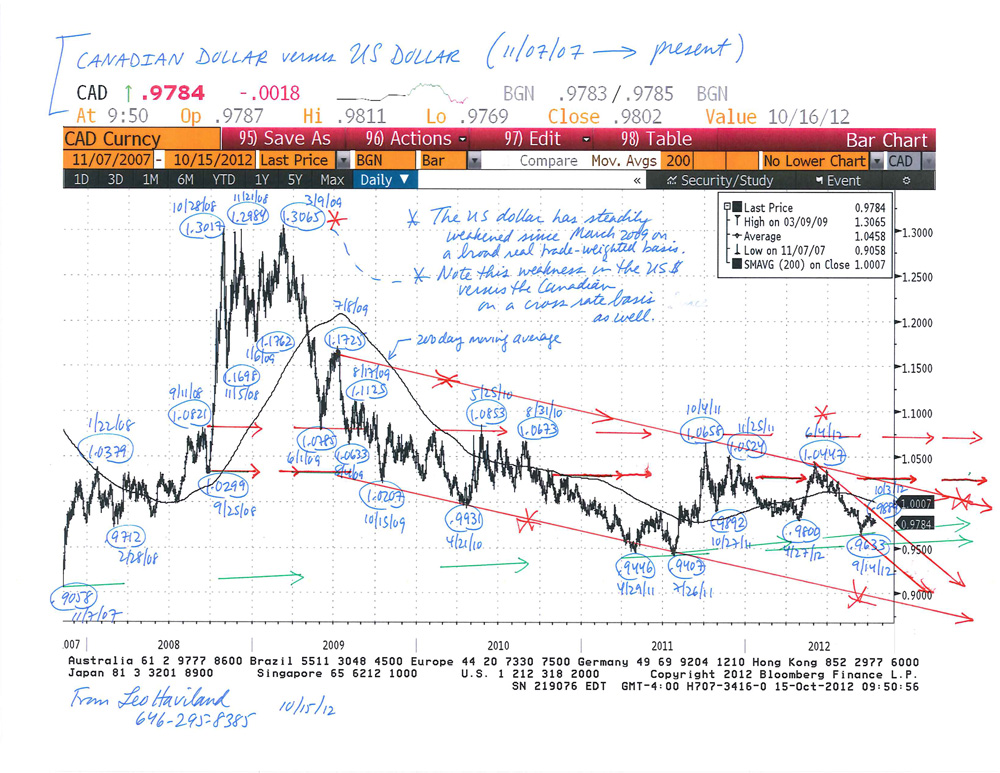
Despite broad concerns regarding worldwide economic problems and risks, despite the widespread past and current fascination with the European scene, suppose one focuses on aspects of the American stage, beginning with some highlights involving the United States alongside Canada and Mexico in the foreign exchange context. This survey of America and its geographic neighbors underlines the weakness of the United States dollar and the size of America’s fiscal troubles. This suggests the merit of inquiring into US currency, stock, interest rate, and commodity marketplace past and future relationships in the context of Federal Reserve easing policies and America’s fiscal problems.
The broad real trade-weighted dollar probably will continue to weaken. The dangerous United States fiscal situation probably will not be genuinely fixed in the next several months. A full- fledged threat of a federal fiscal catastrophe likely will be necessary for sufficient progress in that sphere to occur. Though the United States is not the center of the universe, the effects of further dollar feebleness and the worsening of the country’s fiscal crisis will radiate worldwide.
The S+P 500 has made or soon will make a significant peak.
Thus the emerging (current) story and trend appears to be: weaker dollar (TWD), weaker S+P 500, and higher government rates (UST 10 year benchmark). This vision admittedly is dramatically different from the current popular faith in these marketplace relationships.
FOLLOW THE LINK BELOW to download this market essay as a PDF file.
American Marketplaces- At the Crossroads (10-15-12)
Charts- US Dollar v Canadian Dollar, Mexican Peso (10-15-12)
The long running bull march in the Japanese Yen from early summer 2007 to the current time generally coincides with a continuing worldwide economic crisis. The Yen’s robust strength mirrors the failure by central bankers and politicians around the globe to cure the lamentable financial ills. National policies often differ. The international guardians frequently coordinate their rescue and stimulus programs. Yet measures such as deficit spending, money printing, efforts to keep government interest rates near the floor, and struggles to maneuver currency rates merely have patched and postponed severe problems, not genuinely repaired them. Worrisome debt and leverage issues revealed in 2007-08 lurk on in various forms.
The rally in the Japanese Yen on an effective exchange rate basis since around July 2011 warns that an acceleration of the worldwide crisis, as in mid-2008, may be underway or very near to commencing. Significantly, the climb in the Yen cross rate versus the US dollar since mid- March 2012 also fits the ongoing international economic weakness story. Recall that as the world economy deteriorated more and more quickly around mid-2008, not only did the US dollar rally on a broad real trade-weighted basis, but also the dollar weakened relative to the Yen. The strong dollar equals weak stocks (and weak commodities in general), weak dollar equals strong equities (and bullish commodities) chant remains popular.
The world and perspectives on it are not immutable, so 2012 does not precisely duplicate 2008. Yet given the experience of 2008, what does a rally by the dollar in general, if accompanied by a rally in the Yen (effective exchange rate), and especially if the Yen also marched higher against the dollar on a cross basis, portend? This would hint that the disturbing international crisis is in the process of becoming more fearful. And since March 2012, that seems to be what has been happening.
The current dangerous situation in the ongoing worldwide economic crisis, if it further worsens (and it probably will worsen to some extent, even if the deterioration is not nearly as severe as in 2008), will be sufficiently severe to induce policy makers around the globe to take further substantial steps in their struggles to provide long-lasting remedies. Perhaps such actions by central bankers and political leaders may occur relatively soon. These may issue from individual nations in somewhat piecemeal fashion. Yet there is a substantial chance that intervention will be relatively coordinated, especially if an encore of second half 2008 looks more and more to be underway.
But in the meantime, for the near term, the Japanese Yen probably will keep rallying on an effective exchange rate basis; it probably will breach the 1/16/12 daily low of 187.5. The Yen likely will retest the Y75 level against the dollar. However, the US dollar (TWD) will remain fairly strong. The bear trend in worldwide equities and commodities in general therefore probably is not over. Renewed sustained weakness in both the Yen and the dollar would indicate an easing of the current stage of the global crisis.
FOLLOW THE LINK BELOW to download this market essay as a PDF file.
2008 Revisited- Japanese Yen Strength, Global Economic Weakness (6-4-12)


 View Leo Haviland’s profile